
LiftMaster Gate Repair in San Diego: A Homeowner’s Guide
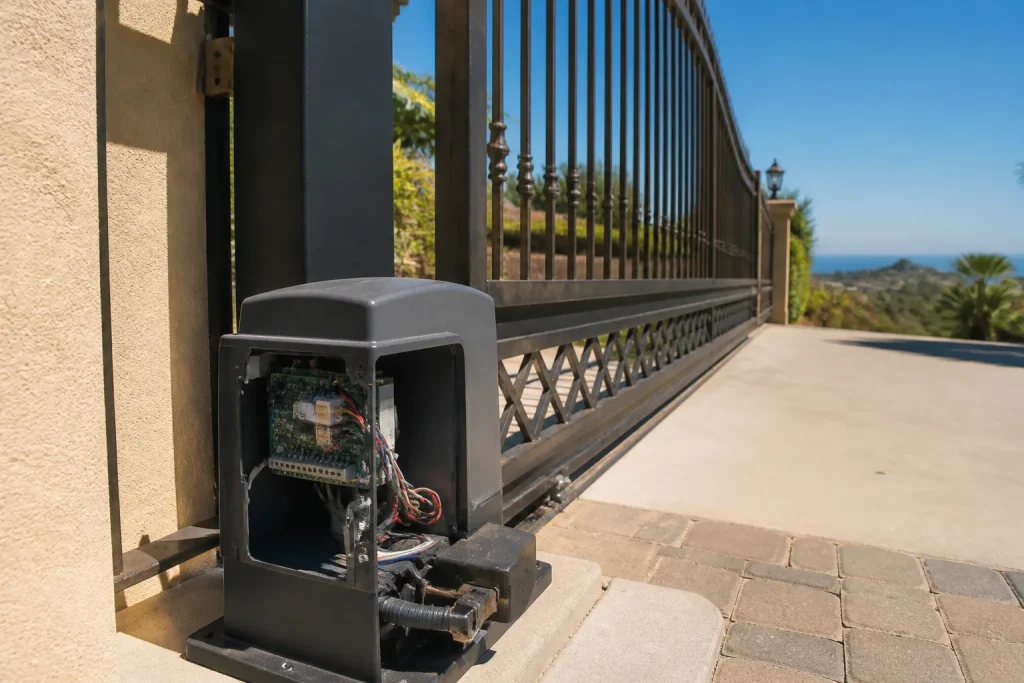
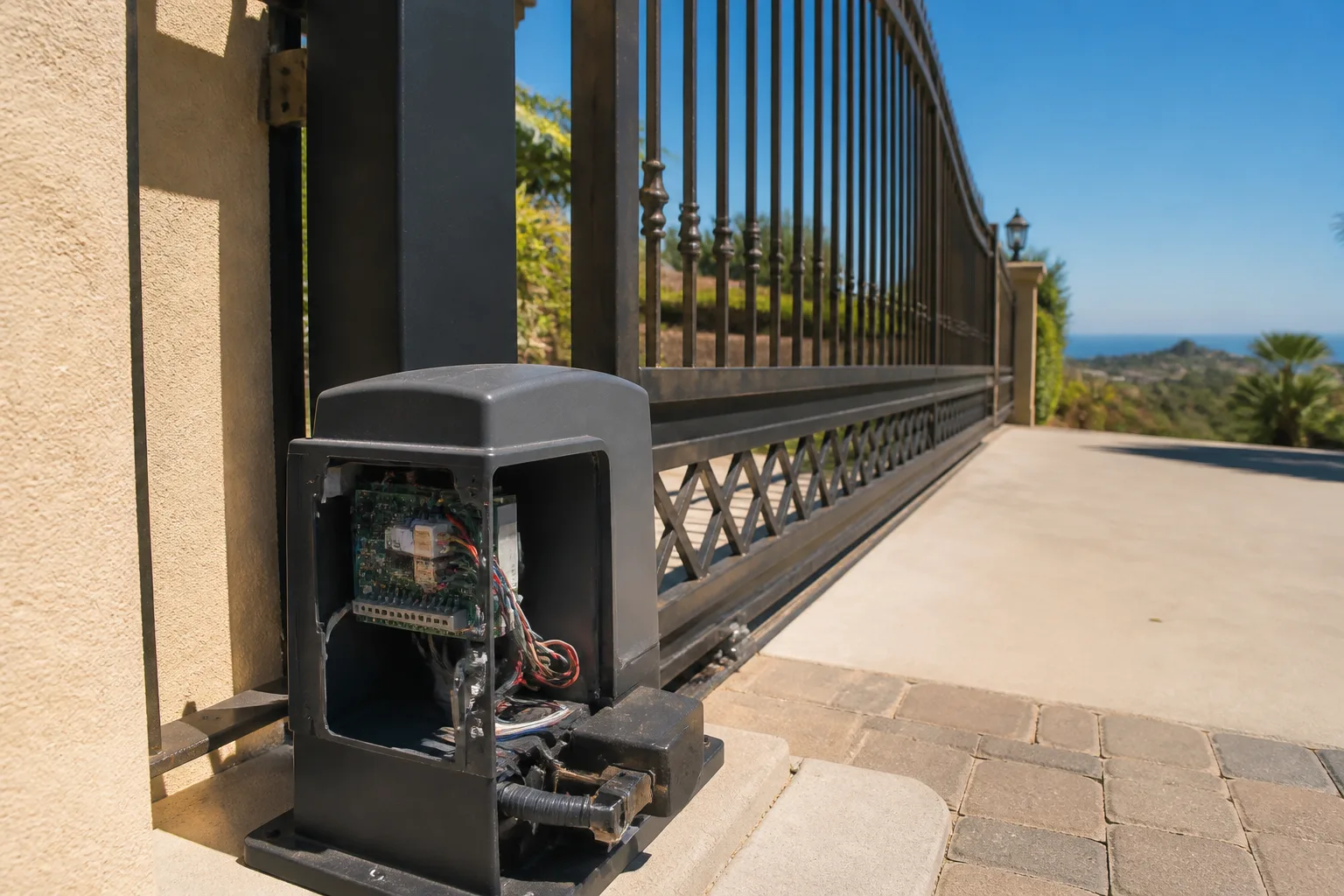
Most LiftMaster gate failures in San Diego aren’t motor failures at all. They’re programming failures. The LA400 and CSW200 series operators we pull service calls on across the county usually have a perfectly healthy board, motor, and limit assembly sitting underneath a pile of settings that were never configured for the actual gate they’re driving. That’s the repair most homeowners need, and it’s rarely the one they’re quoted. If you’d rather skip the diagnostic rabbit hole, call (833) 589-8195 and we’ll sort it out.
Key Takeaways
- The LA400, LA500, and CSW200 are the most common LiftMaster residential operators in San Diego County, and they share the same programming weaknesses.
- Factory-default force and limit settings are calibrated for a demo bench, not a 30-foot swing arc with wind load. This causes premature limit switch wear.
- Diagnostic LED blink codes on the control board will tell you more than the myQ app will in most failure scenarios.
- A failed transformer and a failed control board produce similar symptoms but very different invoices. Knowing which one you have matters.
- San Diego’s heat is a battery killer. A backup battery that tests fine in January can fail during a September heat event when the gate is already working hard.
Why Factory Default Settings Wear Out Your Limits
Here’s what the LiftMaster installation manual doesn’t emphasize enough: the limit settings that leave the factory are placeholders. They assume a gate with a certain arc travel, a certain mass, and zero environmental resistance. San Diego doesn’t do zero environmental resistance. Coastal wind in Point Loma, canyon gusts in Mission Valley, and inland heat in Santee all change how a gate behaves under load. When limits are set too tight, the operator slams into the mechanical stop every cycle. When they’re set too loose, the gate overshoots and the limit switch never triggers cleanly.
On LA400 and LA500 models, the limit assembly uses a cam system that physically depresses a microswitch at each end of travel. Every time the gate over-travels, the cam takes impact. Over six months of daily cycles, that’s a microswitch that gets hammered hundreds of times. The switch fails, the gate loses its end stop, and suddenly you have a swing gate that doesn’t know where “closed” is. That’s the call we get: gate runs fine but won’t stay closed. The fix is a $25 limit switch and a proper re-program. The misdiagnosis is a $400 control board replacement. One of those gets quoted a lot more often than the other.
The same logic applies to force settings. LiftMaster’s default force on the CSW200 is conservative enough to protect the operator, but it doesn’t account for what happens to a 600-pound metal gate in a Santa Ana wind event. Too little force and the gate stalls mid-cycle, throwing a fault code. Too much and the gate ignores obstacles is should stop for. The sweet spot is a number that has to be dialed in on-site. No factory default will get you there.
Reading LiftMaster Blink Codes Without the Dealer App
The myQ app is fine for remote open and close, but it’s a blunt instrument for diagnosis. The control board’s LED is the real tell, and the four most common blink sequences we see in San Diego correspond to very different problems:
- Two blinks, pause, repeat: Force reversal. Something tripped the obstruction sensor. In San Diego this is often wind pushing against the gate mid-cycle, not an actual obstruction.
- Three blinks: Limit switch stuck or out of range. The gate either over-traveled or the switch is physically jammed. This is the factory-default wear issue described above.
- Four blinks: Thermal shutdown. The motor got hot. Inland San Diego summers produce this regularly on gates without shade, especially dark gates with full sun exposure from 2pm to 6pm.
- Five blinks: Communication fault between the board and the motor sensor. This usually means a loose harness connector or a sensor that’s drifted out of alignment, not a dead board.
If you’re staring at a blink code you don’t recognize, take a photo or short video of the LED pattern before you call anyone. A good technician can tell you what’s wrong from that pattern alone, and you’ll avoid paying a service fee for someone to stand in your driveway and squint at the same board.
We’ve had customers in Rancho Santa Fe hand us a list of blink patterns over the phone, and half the time we’ve got a part on the truck before we roll. That’s the difference between a gate specialist and a general contractor: we know what the board is saying before we get there. If you’re in Rancho Santa Fe and need gate repair, the same applies.
Transformer vs. Control Board: The $300 Misdiagnosis
A dead gate is a dead gate. The operator shows no power, the keypad does nothing, and the remote gets no response. That symptom set is where most quick quotes default to “control board failed.” Sometimes that’s right. Often it’s wrong.
The transformer converts 120V household current down to 24V for the control board and motor. When a transformer fails, the board gets no power at all. It looks exactly like a dead board. In our experience across San Diego, transformer failures are actually more common than board failures on LiftMaster operators because of the county’s power conditions. Coastal salt air corrodes transformer windings over time. Inland heat degrades the transformer’s insulation. Santee, El Cajon, and the East County corridor have a real problem with power surges during September heat events, and the transformer is the component that absorbs that hit. The board is downstream and usually survives.
A transformer is a $60 to $90 part. A LiftMaster control board is $250 to $400, plus labor to install and re-program. The test takes ten minutes with a multimeter. If voltage is present at the transformer output but absent at the board, the transformer isn’t the problem. If voltage is absent at both, the transformer never delivered power in the first place. A technician who skips that test and swaps the board is either guessing or billing for a part you didn’t need.
We also work on electric gate repairs in Rancho Santa Fe where this exact scenario plays out with surprising frequency.
Battery Backup and San Diego Heat: Why January Tests Lie
LiftMaster battery backup systems are sealed lead-acid units, and lead-acid chemistry is temperature-sensitive in a way that San Diego homeowners discover exactly when they can least afford a failure: during a heat wave. The battery that tests at proper voltage in January’s mild conditions will drop dramatically in September when ambient temperatures in direct sun exceed 110°F on the gate operator housing.
We recommend testing backup batteries in August, not in spring. Better yet, replace them every three years regardless of test results. The cost is under $150 for most LiftMaster models, and that’s cheap insurance for the day SDG&E cuts power during a Santa Ana wind event and your gate is the only thing between the street and your property.
One week last summer we pulled a battery out of a gate in La Jolla that had tested fine in March. In August, the gate lost power during a brief outage and wouldn’t cycle at all. The battery casing had swollen from heat exposure. It was never the chemistry that failed, it was the thermal cycling. That battery lived a hard life, and it didn’t announce its death until the gate needed it.
myQ Disconnects: Network, Antenna, or Board?
myQ connectivity issues in San Diego come in three flavors, and the good news is you can determine which one you have before you spend a dime.
Network issue: myQ scans but finds no network. Your other Wi-Fi devices are also dropping or slow. The router is on the far side of the house from the operator. The gate went offline after you changed your password or ISP. This is a network problem, and the test is simple: can your phone see your home network from the gate? If not, the operator’s antenna can’t either. A Wi-Fi extender or mesh node within 30 feet of the operator solves most of these.
Antenna issue: The operator’s external antenna has corrosion on the connector or physical damage from direct sun. San Diego’s coastal moisture accelerates this. Look at the antenna. If it’s bent, cracked, or has green or white corrosion at the base, that’s a $15 part on most LiftMaster operators. Replace it and the connection usually restores.
Board issue: myQ disconnects and stays disconnected even after power cycling the board and re-pairing. The network is strong at the operator location. The antenna looks fine. This is the rare case where the Wi-Fi module integrated into the control board has failed. That’s a board-level repair, but it’s still a fraction of the cost of replacing the entire operator. LiftMaster boards with integrated myQ are available and serviceable.
The tell for “network vs. board” is consistency. A flaky connection that comes and goes with router restarts is a network problem. A dead connection that never returns after a hard reset is a hardware problem. Start with the antenna. It’s the cheapest fix and the most commonly overlooked.
And here’s the thing about LiftMaster versus other brands: a company like Cambridge Gate Repair works on all of them because we’ve had homeowners in San Diego assume the myQ system is the only option. It’s not. DoorKing, Elite, and similar operators all have their own access control ecosystems. LiftMaster’s is good, but if you’re running a property where the myQ platform isn’t serving you, there’s a conversation to have about what does. We’d rather fix the gate you have than sell you one we prefer.
When to Call a Professional
If your LiftMaster is throwing blink codes and you’re not sure what they mean, or the gate has come off its limit settings and won’t stay closed, that’s when a gate specialist saves you time and money. High-tension gate hardware, failing swing arms, and control board diagnostics all carry real risks if you’re working through troubleshooting while standing in front of a moving gate. A gate that reverses unexpectedly can injure. We don’t recommend working inside the control panel of an operator that’s still powered and connected to a gate under load.
If you’re in San Diego and your LiftMaster operator is doing what every other LiftMaster operator does when it was installed without a proper site calibration, the fix is a service call for programming and adjustments, not a full replacement. Related services in San Diego include gate installation in Rancho Santa Fe, and we handle the programming end of every install so the settings match the site, not the demo bench.
The Bottom Line
LiftMaster builds a solid operator, but the hardware is only half the system. The software settings, limit calibration, and environmental adjustments are what keep the gate running past year two. If your LiftMaster gate in San Diego is misbehaving, the answer is probably not a new motor. It’s a proper diagnosis, a settings correction, and possibly a $25 part. Start with the blink codes. Check the antenna. Test the transformer before you replace the board. And if you’d rather have someone who thinks in gates all day handle it, call Cambridge Gate Repair at (833) 589-8195 for a free estimate. We’ll tell you what’s wrong and quote you a price before any work starts.
Frequently Asked Questions
Most LiftMaster gate repairs in San Diego run between $150 and $450 depending on whether you need a limit switch replacement, a transformer swap, or a control board repair. Programming-only service calls are typically under $200. Call (833) 589-8195 for an exact quote, estimates are free.
Yes, most LiftMaster repair calls are handled same-day or next-day depending on scheduling. Limit switch and programming issues don’t require special-order parts. Call (833) 589-8195 in the morning and we’ll get you on the schedule.
That’s usually a limit switch issue or an obstruction sensor false-read. In San Diego wind conditions, the force setting may be tripping on the close cycle. The threshold needs to be calibrated for the specific gate, which is a five-minute on-site adjustment.
Yes. We work on the gate you have, regardless of who installed it. LiftMaster is one of the brands our technicians are trained on, along with DoorKing, Elite, Mighty Mule, and several others. If your operator is fine but the settings are wrong, we fix the settings.
Written by the team at Cambridge Gate Repair, serving San Diego since 2014.
Need Gate Repair Help?
Call Cambridge Gate Repair — licensed & insured, here with fast after-hours help in San Diego.
(833) 589-8195